
Coverdale vs Hollybush?
August 15, 2025
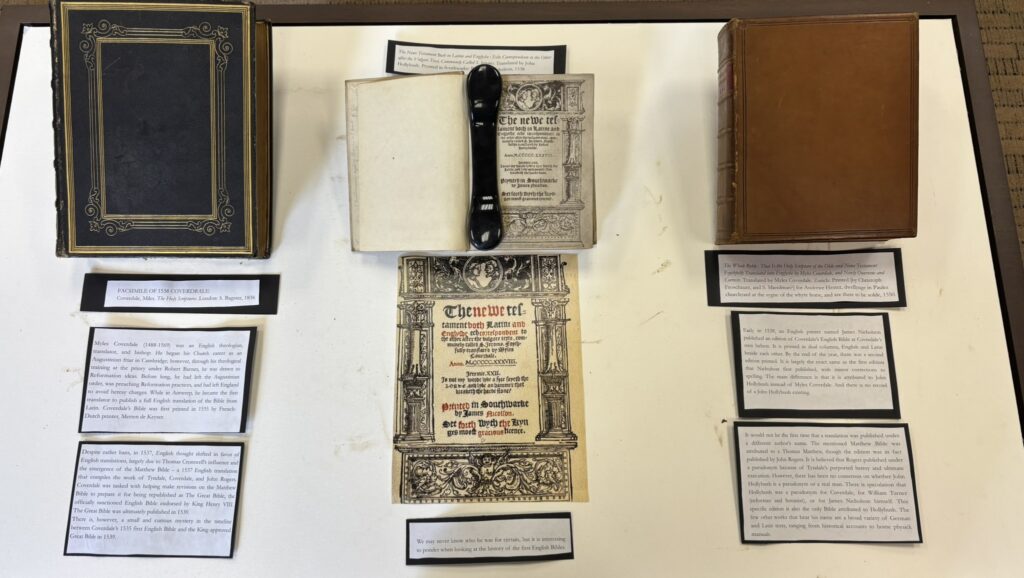
Now on Display:
An 1838 facsimile of Myles Coverdale’s 1538 translation of the New Testament.
Coverdale, Miles. The Holy Scriptures. London: S. Bagster, 1838.
A 1538 translation of the New Testament, attributed to John Hollybush.
The Newe Testament Both in Latine and Englyshe : Eche Correspondente to the Other after the Vulgare Text, Communely Called S. Jeromes. Translated by John Hollybush. Prynted in Southwarke: By James Nicholson, 1538.
A 1550 Coverdale translation of both the Old and New Testaments.
The Whole Byble : That Is the Holy Scripture of the Olde and Newe Testament Faythfully Translated into Englyshe by Myles Couerdale, and Newly Ouersene and Correcte. Translated by Myles Coverdale. Zurich: Printed [by Christoph Froschauer, and S. Mierdman?] for Andrewe Hester, dwellynge in Paules churchyard at the sygne of the whyte horse, and are there to be solde, 1550.
Myles Coverdale (1488-1569) was an English theologian, translator, and bishop. He began his Church career as an Augustinian friar in Cambridge; however, through his theological training at the priory under Robert Barnes, he was drawn to Reformation ideas. Before long, he had left the Augustinian order, was preaching Reformation practices, and had left England to avoid heresy charges. While in Antwerp, he became the first translator to publish a full English translation of the Bible from Latin. Coverdale’s Bible was first printed in 1535 by French-Dutch printer, Merten de Keyser.
Despite earlier bans, in 1537, English thought shifted in favor of English translations, largely due to Thomas Cromwell’s influence and the emergence of the Matthew Bible – a 1537 English translation that compiles the work of Tyndale, Coverdale, and John Rogers. Coverdale was tasked with helping make revisions on the Matthew Bible to prepare it for being republished as The Great Bible, the officially sanctioned English Bible endorsed by King Henry VIII. The Great Bible was ultimately published in 1539.
There is, however, a small and curious mystery in the timeline between Coverdale’s 1535 first English Bible and the King-approved Great Bible in 1539.
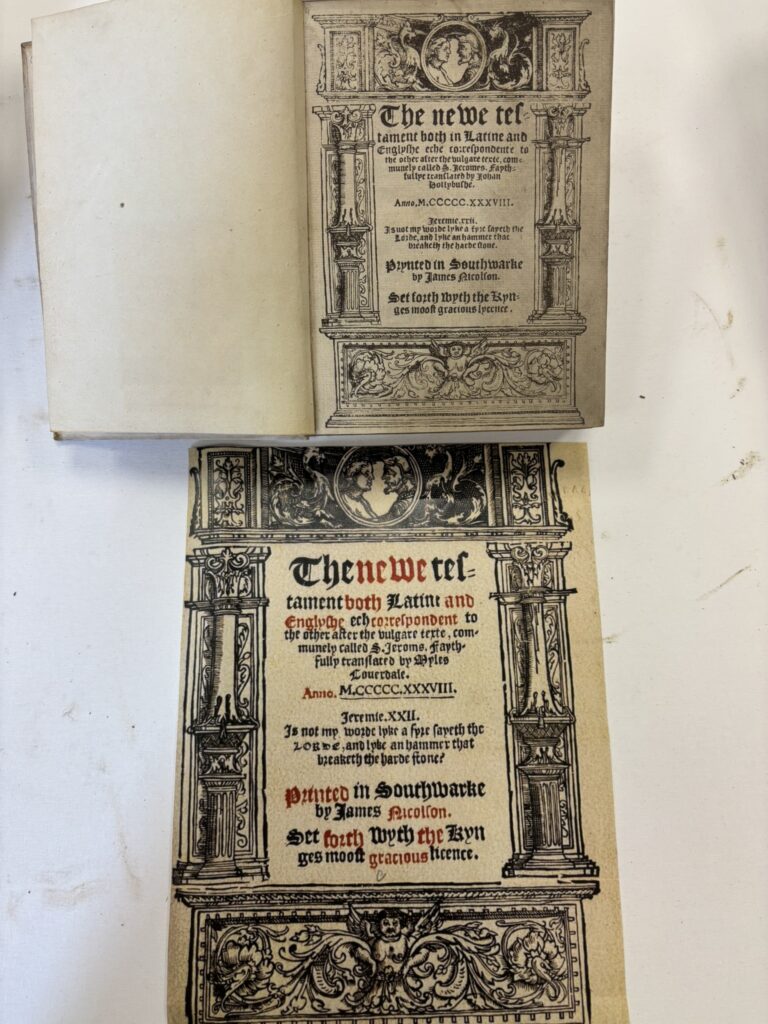
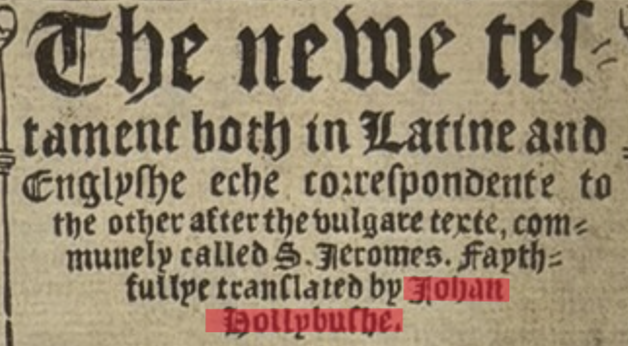
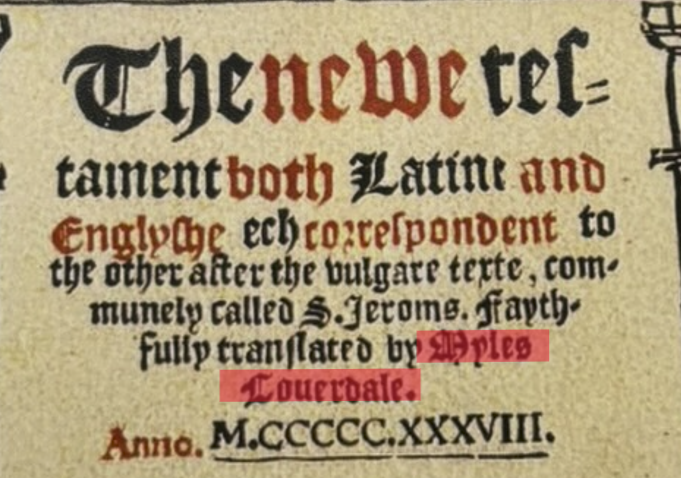
Early in 1538, an English printer named James Nicholson published an edition of Coverdale’s English Bible at Coverdale’s own behest. It is printed in dual columns, English and Latin beside each other. By the end of the year, there was a second edition printed. It is largely the exact same as the first edition that Nicholson first published, with minor corrections to spelling and other small errors. The main difference is that it is attributed to John Hollybush instead of Myles Coverdale. But there is no distinct record of John Hollybush.
It would not be the first time that a translation was published under a different author’s name. The mentioned Matthew Bible was attributed to a Thomas Matthew, though the edition was in fact published by John Rogers. It is believed that Rogers published under a pseudonym because of Tyndale’s purported heresy and ultimate execution. However, there has been no consensus on whether John Hollybush is a pseudonym or a real man. There is speculation that Hollybush was a pseudonym for Coverdale, for William Turner (reformer and botanist), or for James Nicholson himself. It is also thought that maybe Nicholson used this name on a whim because Coverdale was displeased with the errors in the first printing. This specific edition is also the only Bible attributed to Hollybush. The few other works that bear his name are a broad variety of German and Latin texts, ranging from historical accounts to home physick manuals.
We may never know who Hollybush was for certain, but it is interesting to ponder when looking at the history of the first English Bibles.